


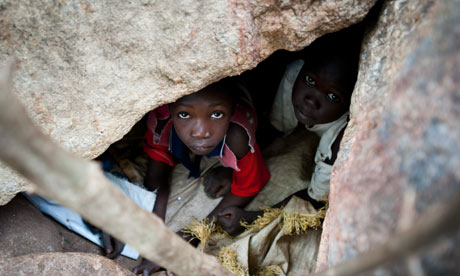
 'Scorched earth tactics are
preventing the Nuba from farming and driving them to hide in cracks and
caves in the mountains.' Photograph: Phil Moore for the Guardian
'Scorched earth tactics are
preventing the Nuba from farming and driving them to hide in cracks and
caves in the mountains.' Photograph: Phil Moore for the Guardian
Read by 157 people
My warnings about Darfur were ignored – concerted international action is needed to save Sudan's Nuba from the same fate
As the engines of the Sudanese Antonov bomber
grew louder, everyone started running for their lives: mothers shouting
for their children, the little ones screaming in fear. As the plane
released its deadly payload, I watched as plumes of black smoke curled
into the sky. Burned out of house and home, plagued by hunger, cut off
from aid and relentlessly hunted from the air – this is what it means to
be a Nuba civilian in Sudan today.
Almost two decades ago, as a
British government official, I had the misfortune to witness the last
genocide of the 20th century – in Rwanda in 1994. I also have the
dubious distinction of experiencing the first genocide of the 21st
century. That was in Darfur
in 2004 and it unfolded while I served as the chief of the United
Nations in Sudan. Earlier this month, I went back across the border into
Sudan's Nuba mountains to see for myself what history may come to judge
as the second genocide of this century.
Walking through the still
smoking wreckage of burned-out Nuban villages, listening to the
traumatised survivors, witnessing the deployment of illegal
anti-personnel mines and cluster bombs, and seeing the destroyed food
stores, schools and churches, memories of Darfur came flooding back. It
is these scorched-earth tactics – first used against the Nuba in the
1990s, then refined in Darfur – that are preventing the Nuba today from
farming and driving them to hide in cracks and caves in the mountains.
The result is growing hunger for some 1.2 million affected Nubans.
This chapter of the conflict opened in June 2011 with the disputed election of Ahmed Haroun
(an indicted war criminal nicknamed the "Butcher of the Nuba") to
govern South Kordofan province. I had seen his handiwork before in
Darfur. My warnings in 2004 were first ignored by world governments and
then taken up only when, in desperation, I went to the media.
The
action that followed was too little too late. Though perpetrators
including President al-Bashir were indicted for crimes against humanity
by the international criminal court, justice and redress have yet to
follow.
Thousands of Darfuris continue to suffer in tightly
controlled desert camps within Darfur and across the border in Chad,
even as Chad's President Deby cements an alliance with Sudan through marriage to the daughter of the Darfur Janjaweed leader Musa Hilal.
The
crimes against humanity in the Nuba stem from Khartoum's declared
vision of a Sudan that does not offer equality for its non-Arab and
non-Islamic citizens. Sudan's most marginalised ethnic African
communities pay the price of such hateful intolerance and extreme
repression.
The world must overcome its torpor to avoid the greater cost of an inevitable later intervention, and I was heartened by the efforts of George Clooney and his colleagues to bring the matter to public attention in Washington last week.
History
teaches that palliative gestures towards Sudan don't work. A
transformation is needed, requiring concerted international engagement.
The human rights emergency in the Nuba mountains requires a UN security
council inquiry into crimes against humanity, along with a further
referral to the international criminal court. Urgent help is needed
through local Nuba structures if Khartoum continues to deny
international access.
Though it is difficult to execute the ICC's
arrest warrants for crimes against humanity, named indictees could be
further sanctioned. And Khartoum's capacity to wage war on its own
citizens must be degraded by stopping official arms transfers and acting
against companies that sell it military equipment. Moreover, the UN,
African Union, Arab League and East African Community must speak with
one voice through a credible joint envoy.
Each of these measures
has been successfully tried in other situations. Given the will, pulling
them together into a coherent package for Sudan is the best hope for
ensuring that the carnage of Darfur and Nuba are not repeated again.


ليست هناك تعليقات:
إرسال تعليق